
EXPLORE THE TOOLKIT


Implementation & practical guidance

State coordination & Wrap-up
INTRODUCTION
Law enforcement may at times encounter situations that involve juveniles. During these initial encounters, it is crucial that officers consider a range of requirements to ensure they handle the situation appropriately and in compliance with appropriate standards. Some of these standards stem from requirements found in the federal Juvenile Justice and Delinquency Prevention Act (JJDPA), a comprehensive federal statute that, among other things, limits the exposure of juveniles to adult facilities and establishes requirements that must be met when exceptions apply. Facilities operated by law enforcement, including jails, lockups, and secure court holding facilities, are subject to inspections and data requests by the state to determine compliance with the JJDPA’s core requirements.

The Office of Juvenile Justice and Delinquency Prevention (OJJDP) administers the JJDPA and provides funding, guidance, and oversight to help states comply with the Act’s core requirements. Because federal funding is tied to state compliance, law enforcement facilities play an important role in ensuring that youth are handled in accordance with the federal standards. The JJDPA represents the first comprehensive federal approach to juvenile justice and remains the primary vehicle through which the federal government establishes standards for state and local juvenile justice systems.
The JJDPA includes the Title II Formula Grant Program which provides direct funding to states to address the needs of at-risk juveniles, prevent juvenile justice system involvement, and strengthen juvenile justice systems. To receive funding, states must commit to achieving and maintaining compliance with the core requirements of the JJDPA which are known as: (1) Deinstitutionalization of status offenders; (2) Sight and sound separation; (3) Jail removal; and (4) the Racial and Ethnic Disparities core requirement. These requirements were established to ensure a minimum level of safety for juveniles involved in the justice system. Failure to comply with these core requirements may jeopardize federal funding used to support state or local programs or agencies that provide services to reduce juvenile involvement in the justice system.
About the Toolkit
This toolkit provides information for law enforcement agencies regarding federal requirements applicable to juveniles held in custody, with particular emphasis on facilities classified as adult jails or lockups, including secure court holding facilities.
The JJDPA establishes the following requirements:
- A prohibition on the detention of youth charged with status offenses;
- Limiting when juveniles charged as adults may be detained in adult facilities;
- Sight and Sound Separation of juveniles from adults in secure facilities and
- Removal of juveniles from adult jails and lockups.
This toolkit focuses specifically on the JJDPA requirements applicable to facilities classified as adult jails or lockups.
How This Toolkit Fits into the State’s Monitoring System
States participating in the Title II Formula Grant Program are required to maintain an effective system of monitoring to ensure compliance with the JJDPA core requirements. See 34 U.S.C. § 11133(a)(14); 28 C.F.R. § 31.303 (monitoring system requirements).
Law enforcement facilities are part of the state’s monitoring universe and may be subject to inspection, data reporting, and classification review.
The following video provides a foundational overview of the JJDPA, the balancing of juveniles’ rights and public safety responsibilities, and practical considerations for managing juveniles in custody within adult facilities.
Developmental Considerations
Research on adolescent brain development demonstrates that how the justice system responds to juveniles can significantly influence future offending. Scientific findings confirm that juveniles are not simply smaller adults; they have reduced capacity for self-regulation, are more susceptible to peer influence, and are less able to fully assess long-term consequences of their decisions.
For these reasons, policies and practices involving juveniles should reflect a developmental approach. While the goals of the justice system remain consistent — to provide accountability, prevent further offending, and ensure fair treatment — a developmental approach ensures that juveniles are managed in environments appropriate to their age and status.
The JJDPA reflects this understanding by establishing standards governing the use of adult jail or lockup facilities. Compliance with these standards not only determines a state’s eligibility for federal funding, but also supports the safe, developmentally appropriate handling of juveniles — an approach shown to reduce recidivism.
Requirements Applicable to Adult Jail or Lockup Facilities
Deinstitutionalization of Status Offenders (DSO)
A juvenile is considered a status offender if charged with or adjudicated for conduct that would not be criminal if committed by an adult (e.g., truancy, runaway, curfew violations).
The DSO core requirement prohibits the secure detention or confinement of:
- juveniles charged with or adjudicated for a status offense;
- juveniles not charged with any offense;
- juveniles who are unauthorized immigrants; and
- juveniles alleged to be dependent, neglected, or abused (non-offenders).
Requirements for Juveniles Charged as Adults and Detained in Adult Facilities
Juveniles prosecuted in criminal court (i.e., waived, transferred, or certified) shall not have sight or sound contact with adult inmates and may not be detained in an adult jail or lockup unless a court determines, after a hearing and in writing, that detention is appropriate under the standards set forth in 34 U.S.C. § 11133(a)(11)(B).
The court must make the initial determination regarding placement in writing within 6 hours (or 48 hours for rural jurisdictions) after the hearing in which the juvenile was transferred or waived to adult criminal court.
If the court authorizes placement in an adult facility, it must conduct periodic review hearings to determine whether continued detention remains appropriate. These hearings must occur at least:
- every 30 days; or
- every 45 days in rural jurisdictions.
If the court determines that a juvenile is to be held in an adult facility, the court order must contain the following 7 elements to comply with the juveniles charged as adults requirements of the JJDPA:
- the age of the juvenile;
- the physical and mental maturity of the juvenile;
- the present mental state of the juvenile, including whether the juvenile presents an imminent risk of harm;
- the nature and circumstances of the alleged offense;
- the juvenile’s prior delinquent history;
- the relative ability of adult and juvenile detention facilities to meet the needs of the juvenile and protect public safety; and
- any other relevant factor.
A juvenile charged as an adult may not be detained in an adult jail or lockup for more than 180 days unless:
- the court determines, in writing, that good cause exists for an extension; or
- the juvenile waives the 180-day limitation.
To assist in determining when a person meets the federal definition of an adult inmate under 28 C.F.R. § 31.304, click here to access the OJJDP Adult Inmate Decision Tree.
The following video explains the JJDPA requirements that apply when a juvenile is prosecuted in criminal court and outlines the continued protections that must be maintained while the juvenile is held in an adult facility.

Sight and Sound Separation Requirement
Juveniles detained or confined in adult jails, lockups, or secure court holding facilities shall not have sight or sound contact with adult inmates.
Sight or sound contact includes any physical, clear visual, or verbal contact between a juvenile and an adult inmate.
States must maintain policies requiring that staff supervising juveniles in facilities that also house adult inmates receive appropriate training related to juvenile supervision, as described in Section V of this toolkit.
Jail Removal Requirement
Juveniles accused of delinquent offenses shall not be detained or confined in adult jails or lockups except as permitted under limited statutory exceptions.
An adult jail or lockup is defined as a secure facility that a state, unit of local government, or law enforcement authority uses to detain or confine adult inmates, including secure court holding facilities.
The exceptions do not apply to juveniles who have already been adjudicated as delinquent, or juveniles who are charged with or have committed an offense that would not be criminal if committed by an adult (i.e., unruly youth or status offenders). These juveniles should not be detained or confined in an adult jail or lockup facility for any length of time, and doing so would result in a violation of the JJDPA.
Exceptions to the jail removal requirement can only be used if the juvenile in question does not have sight or sound contact with adult inmates. In addition, there must be a state policy in effect that requires staff who work with both juveniles and adult inmates to be trained and certified to work with juveniles. For more information on staff training requirements, refer to Section V.
The following video discusses how the JJDPA Jail Removal Requirement applies during extended investigations and provides practical guidance on using secure and non-secure custody options appropriately.
The exceptions to the jail removal requirement are as follows:
Statutory Exceptions to the Jail Removal Requirement
1. Six-Hour Exception
A juvenile accused of a delinquent offense may be held in an adult jail or lockup for a brief period not to exceed six hours for:
- identification,
- processing,
- release,
- transfer to a juvenile facility, or
- while awaiting a court appearance.
2. Rural Exception
A juvenile awaiting an initial court appearance may be held in an adult jail or lockup located outside a Metropolitan Statistical Area (MSA), as defined by the Office of Management and Budget, when no acceptable alternative placement exists. Detention may not exceed 48 hours, excluding weekends and holidays.
Prior to using the Rural Exception, a facility must coordinate with the state’s Designated State Agency (DSA) and compliance monitor to determine eligibility and applicable conditions.
Information on MSAs can be found at: Office of Management and Budget – Metropolitan Statistical Area Bulletins
3. Travel Conditions Exception
A juvenile accused of a delinquent offense can be detained or confined in a jail or lockup for adults if the facility is located where the conditions for travel or the lack of highway, road, or transportation do not allow for a court appearance within 48 hours, excluding weekends and legal holidays. In such cases, a brief (not to exceed an additional 48 hours) delay is allowable.
4. Conditions of Safety Exception
A juvenile accused of a delinquent offense may be detained or confined in a jail or lockup for adults if the facility is located where conditions of safety exist, such as severely adverse, life-threatening weather conditions, that do not allow for reasonably safe travel. In such cases, the juvenile’s court appearance may be delayed until 24 hours after such conditions allow for reasonably safe travel.
States must report all instances in which juveniles are detained in adult jails or lockups, including court holding facilities.
If one or more jail removal exception is used, documentation must include:
- the juvenile’s name or identification number;
- the juvenile’s date of birth;
- the most serious presenting offense;
- the exact time of entry into secure confinement;
- the juvenile’s cell location;
- the exact time and reason for release and to whom the juvenile was released; and
- documentation demonstrating how the statutory exception was satisfied (e.g., severe weather, road conditions, rural facility designation).
The designation “adult jail or lockup” applies only to secure areas, including lockable interview rooms and areas that are unlocked but contain cuffing rails or benches. Administrative areas within a larger secure perimeter are considered secure.
The jail removal requirement does not apply to non-secure areas such as lobbies, offices, conference rooms, or roll call rooms located outside a secure perimeter.
To assist facilities in determining whether a statutory jail removal exception applies and ensuring required documentation is completed, the following operational checklist may be used at intake.
This checklist is intended to supplement — not replace — agency policy and coordination with the state’s compliance monitor and DSA. Use the following checklist to determine whether an exception applies and, if so, how long a juvenile may be detained.
Other Considerations
States may enact requirements that are more restrictive than federal law. Agencies must ensure compliance with both federal and applicable state law, as state law may impose additional limitations beyond the JJDPA.
Law enforcement agencies should coordinate with their state compliance monitor and Designated State Agency (DSA) to confirm applicable state-specific requirements and avoid potential violations.
Contact information for state compliance officials is available through the Office of Juvenile Justice and Delinquency Prevention which can be found here: State Support | Office of Juvenile Justice and Delinquency Prevention.
FACILITY CLASSIFICATION
Periodic onsite reviews conducted by the state’s compliance monitor(s) typically identify which areas of a facility are classified as secure and which are classified as non-secure. The review should also specify which juveniles, if any, may permissibly be detained or confined in each area, the length of time a juvenile may be detained or confined, and any additional requirements that apply during the period of detention or confinement.
States are required to identify and classify facilities that have the potential to securely detain juveniles, including publicly and privately-operated facilities. The classification process includes determining whether the facility is residential or non-residential; adult, juvenile, or both; collocated or not; and whether it may qualify for a jail removal exception. A single facility may have multiple classifications across separate or overlapping areas. A facility’s classification is critical to determining which core requirements apply to specific areas of the facility.
States are required to use federal statutory and regulatory definitions when classifying facilities. Facilities may be classified as:
- jails or lockups for adults (including secure court holding facilities);
- secure detention facilities; or
- secure correctional facilities (prisons).
If facility administrators have questions regarding how their facility is classified, they should contact the state’s compliance monitor for clarification. Contact information for state compliance officials is available at: State Support | Office of Juvenile Justice and Delinquency Prevention.
Secure and Non-Secure Areas
A facility may include both secure and non-secure areas as defined under 28 C.F.R. § 31.304.
Secure Areas
A secure area includes construction features designed to physically restrict the movement or activities of persons in custody. Such features may include locked rooms or buildings, fences, or other physical structures that prevent unrestricted exit.
Examples of secure features include, but are not limited to:
- cuffing benches;
- cuffing rails;
- cuffing poles;
- restraint chairs;
- residential holding cells;
- non-residential temporary holding cells; and
- secure booking rooms.
An area may be considered secure even if it is not continuously locked, when physical fixtures restrict egress.
Non-Secure Areas
A non-secure area is designed so that a person may exit the facility without the use of a key, access PIN, pass-fob, or assistance from staff operating a control mechanism.
Examples of non-secure areas may include:
- conference or meeting rooms;
- front office space;
- the front lobby; and
- “soft” (unlockable) interview rooms.
Facilities should work closely with the state’s compliance monitor and Designated State Agency (DSA) to ensure proper classification of all areas and to understand the applicable requirements for managing juveniles within each space
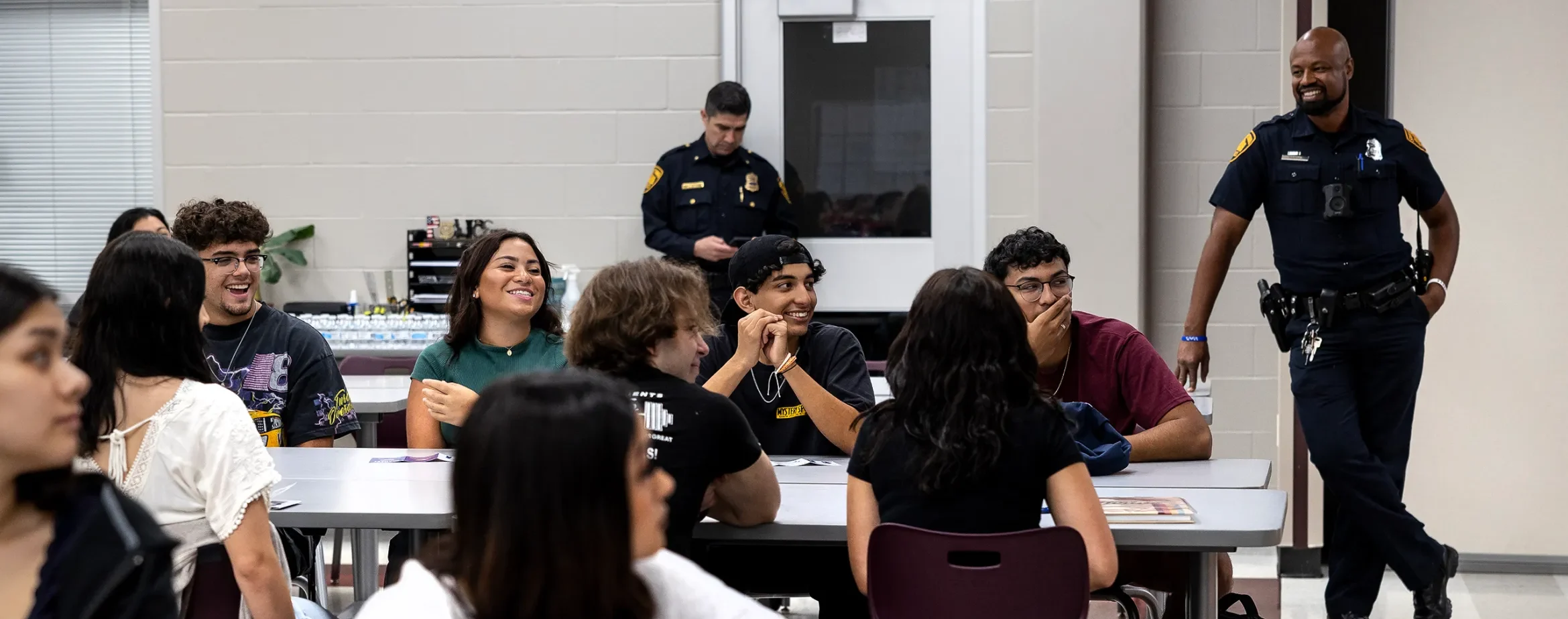
Bria Woods / San Antonio Report. “Students at Marshall Law and Medical Services Magnet School participate in Juvenile Justice Jeopardy.“
STAFF TRAINING REQUIREMENTS AND RESOURCES
Requirements for Staff Working with Juveniles and Adults
The JJDPA requires that staff who work with juveniles held in adult jails or lockups receive appropriate training. Federal law does not prescribe specific training curricula or minimum training hours. Accordingly, states and agencies are responsible for identifying training that satisfies the statutory requirement.
Agencies should consult with their state’s compliance monitor and Designated State Agency (DSA) regarding applicable state policies and training expectations. Contact information for state compliance officials is available at: https://ojjdp.ojp.gov/states
Training provided through a state’s Peace Officer Standards and Training (POST) program, law enforcement academy, or other state-certified training body may satisfy this requirement
Methods of Training
Training may be delivered in a variety of formats, including:
-
- in-service training;
- state-sponsored or POST-certified training;
- online training programs; or
- coursework offered through accredited educational institutions.
Training content may include topics such as:
-
- JJDPA core requirements;
- adolescent brain development and behavior;
- law enforcement interactions with juveniles;
- de-escalation techniques;
- relevant state and federal law; and
- distinctions between juvenile and adult court systems.
COMMON CHALLENGES AND KEY STRATEGIES
Challenge 1: Sight and Sound Separation
Challenge 2: Non-Secure Management of Juveniles in Custody
Challenge 3: Collocated Facilities
Challenge 4: Status Offenders
Challenge 5: Custody of Juveniles After an Initial Appearance
Challenge 6: Separation in Smaller or Older Facilities
Learn more to the right
Summary
Proactive planning, clear policy development, staff training, and coordination with the state’s compliance monitor and Designated State Agency (DSA) are essential to preventing violations of the JJDPA core requirements. Agencies should maintain written procedures and contingency plans to ensure compliance with the core requirements at all times.
Information for state compliance contacts is available at: https://ojjdp.ojp.gov/states.
WORKING WITH THE DESIGNATED STATE AGENCY & COMPLIANCE MONITOR
Each state has a single agency formally designated by the Governor to administer and implement the requirements of the JJDPA. This agency is known as the Designated State Agency (DSA). The DSA works closely with several key individuals responsible for ensuring compliance with the JJDPA, including:
- Juvenile Justice Specialist – Responsible for administration of Title II Formula Grant funds and development of juvenile justice and delinquency prevention programs.
- Compliance Monitor – Responsible for data collection and management, onsite monitoring, and assessing the state’s compliance with the core requirements of the JJDPA.
- State Advisory Group (SAG) Chair – Responsible for facilitating the state advisory group, which advises on the state’s three-year plan and oversight of Title II funding.
- DSA Director – Responsible for overall supervision of the juvenile justice specialist, compliance monitor, and related positions (e.g., Racial and Ethnic Disparities Coordinator, Youth Development Specialist).
OJJDP maintains a website to assist agencies in identifying their state contacts. To locate your state’s contacts, visit: https://ojjdp.ojp.gov/states
Select your state on the map and expand the “State and OJJDP Contacts” section. Because personnel may change periodically, the listed contacts can typically direct you to the appropriate individual if needed.
The DSA serves as a resource for law enforcement agencies regarding the secure and non-secure custody of juveniles and available placement options within the state (e.g., juvenile detention centers, shelter care, diversion programs, court resources). While the DSA may not always be able to resolve an immediate operational issue, coordination with the DSA can help minimize violations and prevent future compliance concerns.
Record Keeping and Reporting
To assist the state in demonstrating compliance with the JJDPA, jails and lockups must maintain accurate and comprehensive data that can be provided to the compliance monitor and/or DSA.
At a minimum, records should include:
- purpose for custody
- most serious offense charged
- case identification number
- date of birth
- race
- sex
- admission date and time
- placement location within the facility (e.g., housing unit, booking room, lobby)
- release date and time
- to whom the juvenile was released
Facilities should work with their compliance monitor and/or DSA to determine:
- what data must be collected,
- how it must be reported,
- applicable reporting timelines, and
- required supporting documentation.
OJJDP provides recommended data elements by facility type.
Placement of Juveniles Charged as Adults
The JJDPA, as reauthorized in 2018, requires states to monitor and document the placement of juveniles prosecuted in criminal court.
The criminal court must issue a written determination addressing the statutory criteria in 34 U.S.C. § 11133(a)(11)(B) before a juvenile who is charged as an adult may be securely detained in an adult jail or lockup or have sight or sound contact with adult inmates.
If such a determination is made, the court must conduct periodic review hearings:
- at least every 30 days (urban jurisdictions); or
- at least every 45 days (rural jurisdictions).
A juvenile may not be securely detained in an adult jail or lockup for more than 180 days unless:
- the court, in writing, determines that good cause exists for an extension; or
- the juvenile waives the 180-day limitation.
Facilities should coordinate with their compliance monitor and/or DSA to determine what documentation (including court orders) must be maintained to demonstrate compliance with these requirements.
The JJDPA permits juveniles charged as adults to have sight or sound contact with adult inmates when the criminal court has issued the written determination. Accordingly, the sight and sound separation requirement applicable to juveniles subject to delinquency proceedings does not apply in the same manner to juveniles charged as adults who are covered by a qualifying court order. While maintaining separation remains a recommended practice whenever feasible, facilities should recognize that the JJDPA permits such contact in these circumstances.
Facilities should also be mindful that PREA’s youthful inmate standard still applies in these cases and must be adhered to.
For a step-by-step framework outlining hearing requirements, review timelines, and the 180-day limitation for placement of Juveniles Charged as Adults, click here to access the Juveniles Charged as Adults Decision Tree.
Preparing for an Onsite Inspection
The JJDPA does not mandate a specific frequency for onsite inspections. However, OJJDP policy recommends that states conduct onsite monitoring of secure facilities at least once every three years.
In practice, this typically results in an onsite review conducted by the compliance monitor approximately every three years, although frequency may vary based on state capacity and monitoring needs.
During an onsite review, the compliance monitor may:
- review facility records and logs (manual or electronic);
- tour secure and non-secure areas of the facility;
- review relevant video documentation;
- interview staff members; and
- interview individuals in custody, as appropriate.
In years when an onsite visit does not occur, facilities may still be required to submit data and documentation to assist the compliance monitor in assessing compliance.
The compliance monitor will coordinate with the facility to schedule onsite visits.
Policies and Procedures
Facilities should develop written policies and procedures addressing compliance with both federal and applicable state requirements governing the secure and non-secure custody of juveniles.
Policies should clearly address, at a minimum:
Secure Custody
- which juveniles may be securely detained or confined
- prohibition on secure detention of status offenders and non-offenders
- length of allowable secure detention
- approved secure locations
- reasons for secure detention
- use of restraints
- sight and sound separation procedures
- monitoring requirements
- movement and transport procedures
- release procedures
- recordkeeping and reporting
- retention of records
Non-Secure Custody
- circumstances requiring non-secure custody
- allowable duration of non-secure custody
- approved non-secure locations
- supervision procedures
- release procedures
- recordkeeping and reporting
- retention of records
Policies should also address:
- procedures for self-reporting violations to the DSA and compliance monitor
- timelines for periodic policy review and updates
CONCLUSION
The secure and non-secure custody of juveniles in adult facilities carries significant legal, operational, and developmental implications. Compliance with the Juvenile Justice and Delinquency Prevention Act (JJDPA) core requirements is not solely a funding condition — it reflects a national commitment to ensuring that juveniles are managed in safe, age-appropriate environments consistent with federal law.
Law enforcement agencies operating adult jails, lockups, and secure court holding facilities play a critical role within the state’s monitoring system. Clear policies, accurate recordkeeping, staff training, proactive operational planning, and ongoing coordination with the Designated State Agency (DSA) and compliance monitor are essential components of maintaining compliance.
By understanding facility classification, applying statutory exceptions appropriately, maintaining sight and sound separation, and ensuring proper documentation, agencies can minimize violations, protect federal funding, and support developmentally informed practices that enhance public safety.
Agencies are encouraged to maintain open communication with state compliance officials and to seek clarification whenever questions arise. Early coordination and preventative planning are the most effective strategies for avoiding compliance concerns.
For state-specific guidance and contact information, visit:
https://ojjdp.ojp.gov/states
For questions regarding this toolkit, training opportunities, or technical assistance, contact Kristi Barksdale at kbarksdale@sheriffs.org.
This toolkit was prepared under Cooperative Agreement Number 15PJDP-22-GK-04989-TITL from the Office of Juvenile Justice and Delinquency Prevention (OJJDP), Office of Justice Programs, U.S. Department of Justice. The opinions, findings, conclusions, or recommendations expressed in this presentation are those of the authors and do not necessarily represent the official position or policies of the U.S. Department of Justice.